Description
Atmospheric Wall Function is a boundary condition used for the turbulent viscosity \(\nu_t\) at the wall in atmospheric boundary layer simulations. It is a specialized condition, designed to represent the effects of turbulence at the ground level in simulations of atmospheric flows, typically within the context of Large Eddy Simulations (LES) or Reynolds-Averaged Navier-Stokes (RANS) simulations.
Unlike other rough wall functions available in SimFlow, where roughness is typically characterized by the diameter of sand grains, this approach does not assume homogeneous conditions. Instead, it considers a much larger scale of roughness, represented by the roughness length, denoted as \(z_0\). This roughness length is the height at which the logarithmic wind profile theoretically reaches zero.
Understanding Atmospheric Wall Function
The calculations of turbulent viscosity \(\nu_t\) are based on turbulent kinetic energy \(k\):
- \(\nu_{t_{w}}\) - Turbulent Viscosity at the Wall \([m^2/s]\)
- \(\nu_w\) - Kinematic Viscosity of Fluid Near the Wall \([m^2/s]\)
- \(y^+\) - Non-Dimensional Wall Distance (Wall Units) \([-]\)
- \(\kappa\) - von Kármán Constant \([-]\)
- \(u^*\) - Friction Velocity \([m/s]\)
- \(C_\mu\) - Empirical Model Constant \([-]\)
- \(k\) - Turbulent Kinetic Energy \([m²/s²]\)
- \(z_0\) - Surface Roughness Length \([m]\)
- \(E^\prime\) - Dimensionless Roughness Parameter \([-]\)
Application & Physical Interpretation
Atmospheric Wall Function is applied at the ground or terrain boundary in atmospheric simulations where the flow interacts with the Earth’s surface.
Atmospheric Wall Function in Wind Comfort applications
Example applications: Wind around Buildings Analysis
These types of simulations can be solved using the simpleFoam (solver). Atmospheric Wall Function is applied together with other turbulent quantities on the walls in order to model the Atmospheric Boundary Layer (ABL).
| Physics | Pressure | Velocity | k | \(\epsilon\) | \(\nu_t\) |
|---|---|---|---|---|---|
Ground | Zero Gradient | Atmospheric Inlet | Standard Wall Function | Standard Wall Function | Atmospheric Wall Function |
| Validation | Description |
|---|---|
SimFlow validation case with a detailed description of wind comfort CFD analysis |
Atmospheric Wall Function in SimFlow
To define Atmospheric Wall Function on the wall boundary, the proper option must be selected from the drop-down menu in the Turbulence tab - Figure 1. Please note that the Turbulence tab will be visible only if the turbulence equations are activated (Turbulence panel).
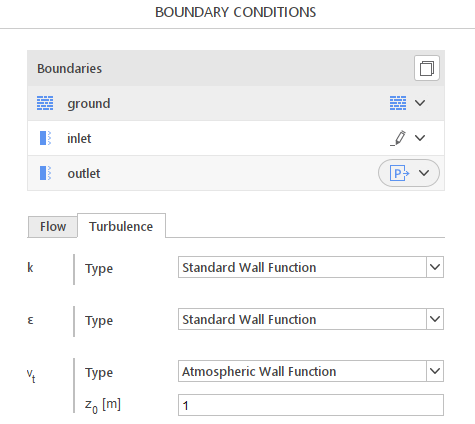
Atmospheric Wall Function - Alternatives
In this section, we propose boundary conditions that are alternative to Atmospheric Wall Function. While they may fulfill similar purposes, they might be better suited for a specific application and provide a better approximation of physical world conditions.
| Boundary Condition | Description |
|---|---|
to model the effects of surface roughness on turbulent flow near walls, based on sand-grain diameter and velocity calculations | |
to model the effects of surface roughness on turbulent flow near walls, based on sand-grain diameter and turbulent kinetic energy calculations |