Description
The Cyclic (AMI) and Cyclic (ACMI) boundary conditions update the values on the boundary faces by interpolating values from a coupled neighbor patch. Often they are used to simulate periodic geometries or flow fields where the periodic faces do not align perfectly.
- Cyclic (AMI) (Arbitrary Mesh Interface) handles cases where the periodic faces do not align perfectly (non-conforming meshes). It assumes full coverage between the owner and neighbor patches.
- Cyclic (ACMI) (Arbitrary Coupled Mesh Interface) extends AMI to handle partial overlap. It allows parts of the interface to be covered (blocked) or uncovered (open) during the simulation.
- \(\phi_{f}\) - final value on the boundary face
- \(\phi_{AMI}\) - interpolated value from the neighbor patch
- \(\alpha\) - mask fraction (1 for AMI/open ACMI, 0 for blocked ACMI)
- \(\phi_{def}\) - default value for the non-overlapping (blocked) portion
Cyclic (ACMI) vs Cyclic (AMI)
Cyclic (ACMI) is a more advanced and versatile boundary condition than Cyclic (AMI). While Cyclic (AMI) handles interpolation between non-matching boundaries (ideal for standard rotating machinery), Cyclic (ACMI) adds the ability to handle interfaces that are inactive or not aligned.
It combines standard interpolation with masking capability, making it particularly useful for: * Rotating machinery with complex geometries. * Cases where a part of the mesh is moving or deforming. * Modeling the opening and closing of parts of the boundary.
Understanding Cyclic (AMI/ACMI)
The fundamental principle of AMI is Galilean transformation and interpolation. When mesh faces on the boundary do not match one-to-one (e.g., due to separate meshing or rotation), the solver computes weights to map data from the source patch to the target patch.
- For AMI: The interpolation weights sum to 1 (\(\alpha=1\)), ensuring flux continuity across the entire interface.
- For ACMI: The method computes a
maskfield. Where the patches overlap, data is transferred. Where they do not overlap, the boundary acts like a wall (or the specified default condition).
Application & Physical Interpretation
These BCs are essential for moving mesh simulations (DyM) and complex connections.
Cyclic (AMI) in Rotating Machinery
Example applications: Wind turbines, pumps, fans
The Cyclic AMI boundary condition is used to model the periodic motion of rotor blades. It allows simulating a sector of the geometry (e.g., one blade) or connecting a rotating rotor mesh to a stationary stator mesh. It maps the flow field from one side to the other, maintaining continuity despite the mesh mismatch.
Cyclic (ACMI) in Sliding Valves
Example applications: Piston engines, gate valves, sliding ports
In cases like a sliding valve where a port opens and closes, Cyclic ACMI is required. The non-overlapping part of the boundary (where the port is covered by the wall) acts as a solid wall preventing flow, while the overlapping part allows fluid to pass through.
Cyclic (AMI/ACMI) in SimFlow
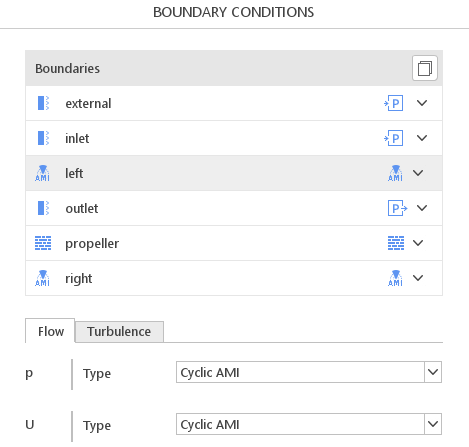
To define Cyclic (AMI/ACMI), the two patches must first be connected into an AMI or ACMI interface in the Mesh panel. Once the interface is created, select the patch in the Boundary Conditions panel and choose the appropriate type.
Cyclic (AMI/ACMI) - Alternatives
In this section, we propose boundary conditions that are alternative to Cyclic (AMI/ACMI). While they may fulfill similar purposes, they might be better suited for a specific application and provide a better approximation of physical world conditions.
| Boundary Condition | Description |
|---|---|
Based on AMI but adds a constant offset (jump) to the value across the interface (e.g. for fan pressure rise). |