Description
Inlet-Outlet Total Temperature is a temperature boundary condition that provides an outflow condition for total temperature. Essentially, it works similarly to Inlet-Outlet. It defines Zero Gradient for the outlet patch, but switches to Total Temperature when the reverse flow is detected on the outlet patch. The user-specified value needs to be defined in case of reverse flow.
Similarly to Total Temperature, the Inlet-Outlet Total Temperature boundary condition is used to calculate the static temperature at the domain boundary, but only when the reverse flow occurs. Otherwise, Zero Gradient is applied.
Understanding Inlet-Outlet Total Temperature
Inlet-Outlet Total Temperature boundary condition adapts the temperature field depending on the flow direction at the outlet. Under normal outflow conditions, a Zero Gradient condition is applied, which effectively extrapolates the total temperature from the interior of the domain to the patch.
The critical scenario occurs when reverse flow is detected, particularly at high velocities. In this case, the boundary condition imposes the user-specified Total Temperature, ensuring that the thermal contribution of the fluid’s kinetic energy is accurately captured.
The Inlet-Outlet Total Temperature boundary condition calculates the static temperature at the patch only when reverse flow occurs.
The formula linking total and static temperature is as follows:
- \(T_0\) – total temperature
- \(T_p\) – static temperature at the patch
- \(\gamma\) – specific heat capacity ratio
- \(\psi\) – compressibility (for fixed composition of gas) expressed as \(\psi = (RT)^{-1}\)
- \(\vec u\) – velocity vector
Application & Physical Interpretation
Inlet-Outlet Total Temperature in High-Speed Flow applications
Example applications: pipe and duct flows
These types of simulations can be solved using the rhoSimpleFoam (solver) or rhoPimpleFoam (solver). Inlet-Outlet Total Temperature can be applied at the outlet when the reverse flow is expected. Such a situation may appear when there is an obstacle in the duct - its shape determines the risk of reverse flows.
| Physics | Pressure | Velocity | Temperature |
|---|---|---|---|
Inlet | Zero Gradient | Flow Rate Inlet Velocity | Fixed Value |
Outlet | Fixed Value | Inlet-Outlet | Inlet-Outlet Total Temperature |
Inlet-Outlet Total Temperature in SimFlow
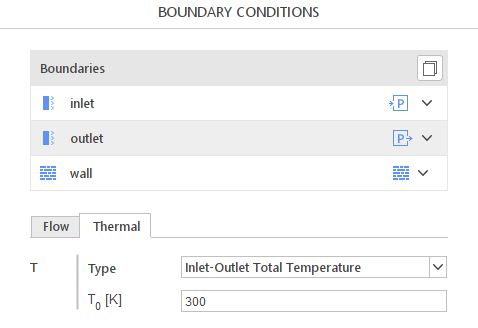
Inlet-Outlet Total Temperature can be selected from the drop-down menu in the Boundary Condition panel. The user needs to provide the Total Temperature \(T_0\) - Figure 1.
Inlet-Outlet Total Temperature - Alternatives
In this section, we propose boundary conditions that are alternative to Inlet-Outlet Total Temperature. While they may fulfill similar purposes, they might be better suited for a specific application and provide a better approximation of physical world conditions.
| Boundary Condition | Description |
|---|---|
prescribes total temperature on the patch | |
belongs to the Neumann boundary conditions, sets the normal gradient of any variable to zero |