Description
Interstitial Inlet Velocity is a Dirichlet (fixed–value) velocity boundary for Euler‑Euler multiphase or porous‑media problems. The boundary condition converts the superficial (bulk) inlet velocity to the interstitial velocity that the solver actually transports by dividing the bulk velocity U by the local phase fraction α.
This boundary condition is useful in multiphase flow simulations when both phases exist at the inlet. Application of Fixed Value for the velocity will result in an incorrect velocity for a given phase, because the prescribed velocity would be scaled by the phase fraction \(\alpha\). Therefore, the resulting mass flow rate through the boundary would be smaller than expected.
Understanding Interstitial Inlet Velocity
Boundary conditions such as Interstitial Inlet Velocity need the true phase velocity to satisfy the phase‑mass balance. Users, however, often know or specify the superficial velocity. The boundary condition therefore divides the user input by the local phase fraction \(\alpha\) to obtain the proper interstitial value that the solver stores in the velocity field.
Mathematically, the interstitial velocity is calculated as below:
- \(\vec U_{inlet}\) – superficial (bulk) velocity provided by the user
- \(\alpha\) – the local volume‑fraction of the phase
In Euler‑Euler formulations, the phase‑mass balance is written for the phase volumetric flux \(\alpha \vec U\). Measurements or design data are usually given as the superficial velocity. The boundary condition simply back‑calculates the velocity the phase really has while occupying only a fraction \(\alpha\) of the patch area.
This guarantees mass‑flux consistency without the user having to monitor α variations during a transient run.
Application & Physical Interpretation
The Interstitial Inlet Velocity is commonly used in multiphase problems. It calculates the true phase velocity based on the user-defined bulk velocity. However, its physical meaning varies depending on the problem being considered and the solver applied.
Interstitial Inlet Velocity in Multiphase applications
Example applications: fluidized beds
These types of simulations can be solved using the multiphaseEulerFoam (solver). Interstitial Inlet Velocity can be applied to the domain inlet to enforce the correct interstitial velocity automatically.
| Physics | Velocity | Pressure | Temperature |
|---|---|---|---|
Inlet | Interstitial Inlet Velocity | Fixed Flux Pressure | Fixed Value |
Interstitial Inlet Velocity in SimFlow
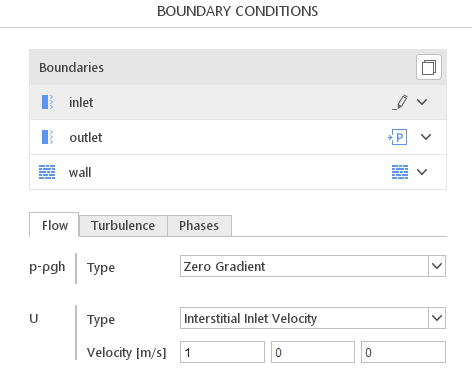
To define Interstitial Inlet Velocity in SimFlow, the proper option must be selected from the drop-down menu for the velocity field - Figure 1.
Interstitial Inlet Velocity - Alternatives
In this section, we propose boundary conditions that are alternative to Interstitial Inlet Velocity. While they may fulfill similar purposes, they might be better suited for a specific application and provide a better approximation of physical world conditions.
| Boundary Condition | Description |
|---|---|
imposes a fixed velocity value without accounting for phase fraction, suitable when the exact interstitial velocity is known or when phase fraction effects should be ignored | |
allows the velocity to be extrapolated from the interior, appropriate for outlets or when the boundary influence should be minimal | |
combines inlet and outlet behavior based on pressure, useful for mixed inflow/outflow boundaries in complex multiphase flows |