Description
Low Re Wall Function is a boundary condition that defines the value for the turbulent viscosity \(\nu_t\) for low-Reynolds number applications. It defines \(\nu_t\) as zero and works similarly to a zero value of Fixed Value. However, the main difference is that Low Re Wall Function provides an access function to calculate the dimensionless wall distance \(y^+ \). Unlike full wall functions (e.g., nutkWallFunction), it does not calculate nut based on \(y^+\) but sets it to zero for direct resolution in the viscous sublayer.
It should be noted that Low Reynolds refers not to the flow, but to the region of the domain close to the wall, where viscous effects dominate. In CFD practice, it means that the near-wall region is well resolved (fine mesh) and wall function modeling is not necessary.
Understanding Low Re Wall Function
Low Re Wall Function is particularly useful when simulating flows where accurate near-wall treatment is necessary without relying on traditional wall functions that approximate the boundary layer. It sets the turbulent viscosity \(\nu_t\) to zero at the wall, which is appropriate for cases where the mesh is fine enough to resolve the viscous sublayer directly:
- \(\nu_t\) - turbulent viscosity \([m^2/s]\)
Application & Physical Interpretation
Low Re Wall Function is crucial for accurately simulating flows in ducts and pipes, but also external turbulent flows where wall effects are significant. Low Re Wall Function is especially useful for simulating flows that require precise near-wall modeling, as it avoids relying on traditional wall functions that approximate the boundary layer. Instead, it allows for accurate resolution of the flow characteristics directly at the wall.
Low Re Wall Function in Pipe Flow applications
Example applications: pipe or duct flow
These types of simulations can be solved using the pimpleFoam (solver). In this case, we assume that the inner surface of the pipe is not perfectly smooth, but rather is characterized by some roughness.
| Physics | Pressure | Velocity | \(k\) | \(\epsilon\) | \(\nu_t\) |
|---|---|---|---|---|---|
Pipe (Wall) | Zero Gradient | No-Slip | Standard Wall Function | Standard Wall Function | Low Re Wall Function |
Low Re Wall Function in Compressible Aerodynamics applications
Example applications: External Aerodynamics (Airfoils)
These types of simulations can be solved using the rhoSimpleFoam (solver).
| Physics | Pressure | Velocity | Temperature | \(k\) | \(\omega\) | \(\nu_t\) |
|---|---|---|---|---|---|---|
Airfoil (Wall) | Zero Gradient | No-Slip | Zero Gradient | Standard Wall Function | Standard Wall Function | Low Re Wall Function |
Low Re Wall Function in HVAC applications
Example applications: Room Heating
These types of simulations can be solved using the buoyantBoussinesqPimpleFoam (solver).
| Physics | Pressure | Modified Pressure \(p_rgh\) | Velocity | Temperature | \(k\) | \(\epsilon\) | \(\nu_t\) |
|---|---|---|---|---|---|---|---|
Room walls (Wall) | Calculated | Fixed Flux Pressure | No-Slip | Fixed Value | Standard Wall Function | Standard Wall Function | Low Re Wall Function |
Low Re Wall Function in SimFlow
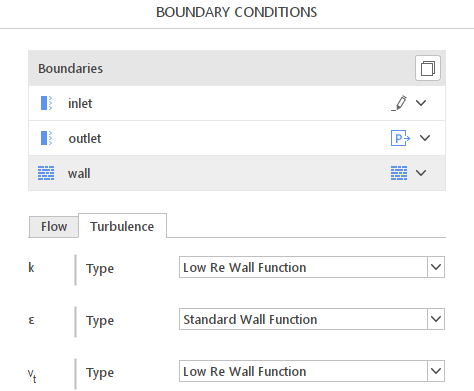
To define Low Re Wall Function on the wall boundary, the proper option must be selected from the drop-down menu in the Turbulence tab - Figure 1. Please note that the Turbulence tab will be visible only if the turbulence equations are activated (Turbulence panel).
Low Re Wall Function - Alternatives
In this section, we propose boundary conditions that are alternative to Low Re Wall Function. While they may fulfill similar purposes, they might be better suited for a specific application and provide a better approximation of physical world conditions.
| Boundary Condition | Description |
|---|---|
fixed value on the patch | |
prescribes turbulent kinetic energy \(k\) for high-Reynolds conditions |