Description
Lumped Mass is a boundary condition that models the temperature on a wall (or boundary patch) whose thermal inertia can be approximated as a single, “lumped” mass. Instead of explicitly resolving temperature gradients within a solid region, this BC treats the wall (or the structure behind the patch) as if it were a single thermal node with a given mass and heat capacity. The boundary condition updates the wall temperature by solving an ordinary differential equation (ODE) that balances the net heat flux into or out of the lumped mass with its rate of temperature change.
It is often used when the transient thermal response of a wall (or a solid structure behind it) needs to be captured without explicitly meshing the solid region. This significantly reduces computational cost while still providing a time-dependent wall temperature for the fluid domain.
Understanding Lumped Mass
To better understand the applicability of the Lumped Mass boundary condition, let us introduce the concept of the Biot number:
- \(h\) - convective heat transfer coefficient \([\frac{W}{m^2·K}]\)
- \(L_c\) - characteristic length of the solid \([m]\), often taken as the ratio of the solid’s volume to surface area
- \(k_s\) - thermal conductivity of the solid \([\frac{W}{mK}]\)
The Biot number compares the internal conduction resistance of a solid to the external convective resistance at its surface.
If the Biot number is much smaller than one (\(Bi << 1\)), the conduction resistance within the solid is small relative to the convective resistance at the surface. In other words, conduction inside the solid is relatively fast compared to heat transfer across the solid–fluid boundary. Consequently, the temperature within the solid tends to be nearly uniform (“lumped” behavior).
Note | The Biot number is not evaluated by the boundary condition itself. It is the user’s responsibility to ensure the physical validity of the lumped mass assumption. |
Mathematically, the wall temperature evolution is given by:
- \(T_w\) - wall (lumped) temperature
- \(Q_{net}\) - net heat rate into the lumped mass
- \(m\) - mass of the lumped body
- \(c_p\) - specific heat capacity
The net heat rate \(Q_{net}\) is calculated as the sum of heat transfer from the fluid side and any external heat inputs (e.g. environmental or radiative heat fluxes).
Finally, the ordinary differential equation for \(T_w\) is integrated in time at each iteration or time step:
Lumped Mass can be used in the following scenarios:
- Single lump approximation is valid - if the wall has a negligible internal temperature gradient and can be approximated with a single “lumped” temperature
- Avoiding meshing a solid region - fewer mesh elements reduce computational cost
- Conjugate Heat Transfer (CHT) approximation - solid regions can be replaced by a lumped thermal response
- Transient simulation - when the boundary temperature must evolve in time and is neither purely fixed nor adiabatic
Application & Physical Interpretation
Lumped Mass is applied to a wall (or boundary patch) that can be treated as having negligible internal temperature gradients, meaning the wall behaves as a lumped thermal mass with a single uniform temperature. Rather than modeling heat conduction inside a solid region, this BC uses an energy balance to update the wall temperature over time based on the net heat flux from the fluid and any external heat inputs.
Physically, this boundary condition represents the wall as a single thermal node, balancing heat input and output with the rate of change of the wall temperature through its heat capacity.
Lumped Mass in Heat Transfer Applications
Example applications: room heating and cooling, HVAC systems, electronics cooling.
Such simulations can be solved using buoyantPimpleFoam (solver). Instead of meshing thick walls explicitly, Lumped Mass can be applied directly to walls to represent their thermal mass.
| Physics | Pressure | Velocity | Temperature |
|---|---|---|---|
Wall | Fixed Flux Pressure | No-Slip | Lumped Mass |
Lumped Mass in SimFlow
Lumped Mass can be selected from the drop-down menu in the Boundary Condition panel, Temperature tab. The user must specify two parameters - Figure 1:
- Lumped Mass in \([kg]\)
- Heat Capacity of the lumped mass \([\frac{J}{kg K}]\)
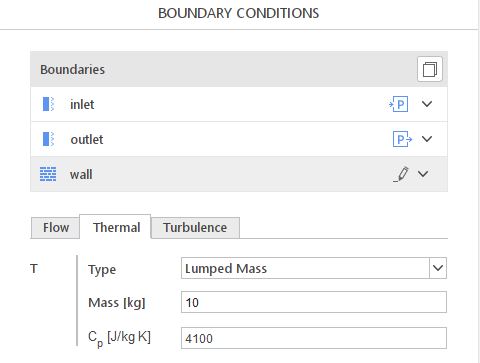
Lumped Mass - Alternatives
In this section, we propose boundary conditions that are alternative to Lumped Mass. While they may fulfill similar purposes, they might be better suited for a specific application and provide a better approximation of physical world conditions.
| Boundary Condition | Description |
|---|---|
fixed value on the patch | |
prescribes total temperature on the patch |