Description
Marshak is a boundary condition used in radiative heat transfer simulations, particularly in high-temperature physics. It models the interaction between radiation and a semi-transparent boundary, accounting for absorption and emission of radiation. This condition is essential in environments where radiation is a significant mode of heat transfer, such as in participating media like gases or plasmas.
The Marshak boundary condition helps in accurately capturing the radiative heat flux at the boundary, enabling realistic simulations of high-temperature and radiative environments.
Understanding Marshak
The Marshak boundary condition is based on the Marshak approximation, which simplifies the radiative transfer equation for semi-transparent boundaries. It accounts for the net radiative heat flux by considering the absorption and emission properties of the boundary.
In the context of the P1 radiation model in OpenFOAM, the Marshak sets the radiative intensity based on the boundary’s emissivity, absorptivity, and transmissivity. This ensures that the boundary behaves as a semi-transparent surface that can absorb, emit, and transmit radiation.
Application & Physical Interpretation
The Marshak is used in simulations where radiative heat transfer is significant, particularly in high-temperature environments with participating media.
Marshak in High-Temperature Furnace Simulations
Example applications: industrial furnaces, combustion chambers, plasma physics
This problem can be solved using the chtMultiRegionFoam (solver) for conjugate heat transfer.
The Marshak is applied to radiative boundaries to model the emission, absorption, and transmission of thermal radiation.
| Physics | Temperature | Radiative Intensity |
|---|---|---|
Furnace Wall | Fixed Value | Marshak |
Inlet | Fixed Value | Fixed Value |
Outlet | Zero Gradient | Zero Gradient |
Marshak in SimFlow
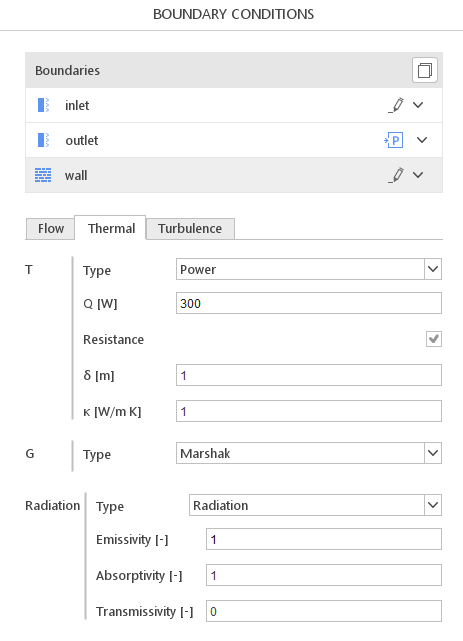
To define the Marshak boundary condition in SimFlow, radiation must be enabled and the P1 model selected. Navigate to the Boundary Conditions panel, select the appropriate boundary, and choose Marshak from the drop-down menu.
Additionally, define the surface properties: emissivity, absorptivity, and transmissivity.
Marshak - Alternatives
In this section, we propose boundary conditions that are alternative to Marshak. While they may fulfill similar purposes, they might be better suited for a specific application and provide a better approximation of physical world conditions.
| Boundary Condition | Description |
|---|---|
Used for opaque surfaces in radiative heat transfer. | |
Similar to Marshak but with fixed temperature. |