Description
Matched Outlet is a boundary condition used to dynamically adjust the velocity distribution at an outlet so that the net flow rate (mass or volumetric) across that boundary patch matches a user-specified inlet. It iteratively corrects the boundary velocity profile so that the integrated flow rate at the outlet aligns with the desired inlet.
In many engineering and CFD simulations, it is common to specify an exact outflow rate rather than a fixed velocity at an outlet. For instance, the net flow leaving the domain might be known, but not a velocity profile in advance. Traditional boundary conditions like Fixed Value or Zero Gradient cannot directly guarantee a specific total flow rate. Matched Outlet is designed to solve this problem.
Understanding Matched Outlet
Mathematically, the boundary condition can be expressed as:
- \(Q\) - mass or volumetric flow rate
- \(\rho\) - density; for an incompressible case, \(\rho\) is constant.
- \(\vec{u}\) - velocity vector
- \(d\vec{A}\) - area vector
Matched Outlet is a sophisticated boundary condition that bridges the gap between Fixed Value or Zero Gradient conditions and the practical necessity of controlling outflow rates in CFD simulations. It provides a feedback loop that adjusts the outlet velocity distribution to achieve a predefined mass or volumetric flow rate, leading to more realistic and controlled simulation outcomes.
Matched Outlet is similar to Flow Rate Outlet Velocity. However, unlike that condition, which sets a fixed target flow rate, Matched Outlet automatically adjusts based on the specified inlet. In other words, if the inlet flow changes, Matched Outlet dynamically updates the outlet conditions accordingly.
Application
Matched Outlet is applied at the exit of the domain to prescribe the flow rate, based on the inlet mass or volumetric flow. In a real-world scenario, if the amount of fluid entering a domain changes, the outflow typically adjusts naturally to maintain mass conservation. The Matched Outlet boundary condition mimics this behavior numerically.
Matched Outlet in HVAC applications
Example applications: ducting and ventilation systems
These types of simulations can be solved using the buoyantSimpleFoam. In ventilation simulations, very often the inlet flow is known as it is controlled by the fan. Applying Matched Outlet at the outlet ensures that the outlet condition automatically adapts to the inlet.
| Physics | Pressure | Velocity |
|---|---|---|
Velocity Inlet | Zero Gradient | Flow Rate Inlet Velocity |
Velocity Outlet | Zero Gradient | Matched Outlet |
Matched Outlet in Multiphase (VoF) applications
Example applications: desorption column
These types of simulations can be solved using the interFoam. Proper vapor and liquid flow through the packing material enhances the heat transfer needed for stripping \(CO_2\) from the solvent in the desorption column.
| Physics | Pressure | Velocity |
|---|---|---|
Liquid Inlet | Fixed Flux Pressure | Flow Rate Inlet Velocity |
Liquid Outlet | Total Pressure | Matched Outlet |
Matched Outlet in SimFlow
The definition of boundary conditions in SimFlow is both simple and intuitive. To specify the Matched Outlet boundary condition, the user must navigate to the Boundary Conditions panel, select the appropriate boundary, and choose the correct option from the drop-down menu.
Matched Outlet requires specifying an inlet boundary that will serve as the reference point for calculating the flux - Figure 1.
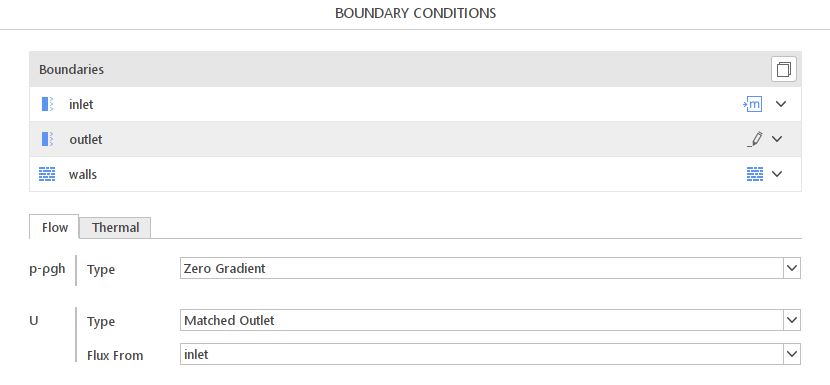
Flux From - specifies the inlet patch from which the flow rate is taken to match at this outlet patch.
Matched Outlet - Alternatives
In this section, we propose boundary conditions that are alternative to Matched Outlet. While they may fulfill similar purposes, they might be better suited for a specific application and provide a better approximation of physical world conditions.
| Boundary Condition | Description |
|---|---|
fixes the volumetric or mass flow rate at the outlet of the domain | |
fixed value on the patch, constant over time | |
fixing the value of a vector field by specifying the magnitude | |
uniform value on the patch, which varies over time |