Description
Outlet Phase Mean Velocity is a mixed‑type outlet boundary for a single phase in VOF/Euler–Euler, two‑phase or free‑surface cases.
Its purpose is to keep the mean normal (superficial) velocity of the chosen phase at a user-defined value by adjusting the patch velocity every time‑step.
Typical use: the water outlet of a towing tank or wave tank — the water level at the outlet needs to stay equal to the inlet even when the internal flow field fluctuates.
Understanding Outlet Phase Mean Velocity
The boundary condition calculates the outlet phase mean velocity in several steps. First, it calculates the phase mean zero-gradient velocity \(\bar U_{mean}^{zg}\):
- \(\alpha_i\) – phase fraction on the face
- \(S_i\) – patch faces i with outward area vector
- \(|S_i|\) – area of the face
- \(U_i^{zg}\) – internal (zero‑gradient) velocity on the face
When \(U_{mean}^{zg}\) is known, the mixing fraction \(f\) is derived:
- \(U_n^{**}\) – the user-prescribed mean velocity at the outlet
In the next step, the reference velocity is obtained:
Because the correction uses the phase‑fraction‑weighted mean, the method works even if the water surface undulates across the outlet: it regulates the mass flow of that phase, not the total flux.
Application & Physical Interpretation
Outlet Phase Mean Velocity continually adjusts the outlet velocity of one phase so that its mean normal component matches a user-defined target, automatically compensating for transient variations in the phase fraction and preserving global mass balance.
Outlet Phase Mean Velocity in Marine applications
Example applications: hull/ship motion
These types of simulations can be solved using the interFoam (solver). Outlet Phase Mean Velocity helps to keep the water level at the same value, representing the open sea conditions.
| Physics | Modified pressure p_rgh | Velocity | Phase |
|---|---|---|---|
Outlet (domain) | Zero Gradient | Outlet Phase Mean Velocity | Variable Height |
Outlet Phase Mean Velocity in SimFlow
The Outlet Phase Mean Velocity boundary condition is used for the velocity field, typically at the outlet out of the domain. To select it, in the boundary condition tab, the proper option must be selected from the drop-down menu - Figure 1.
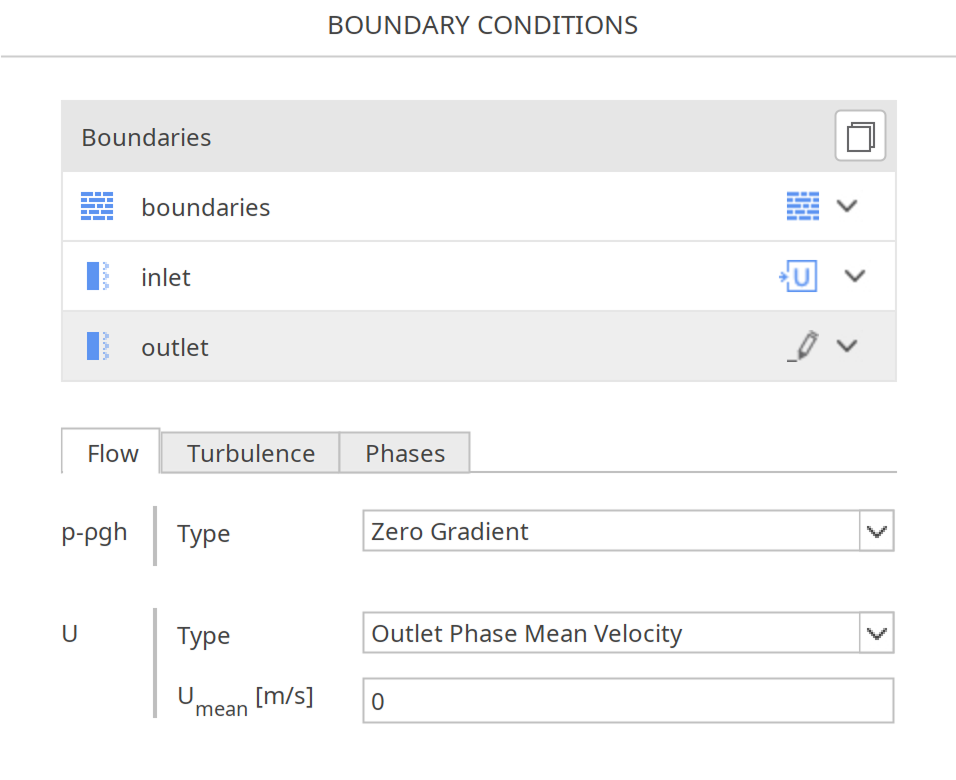
The mean velocity must be specified by the user.
\(U_{mean}\) - mean phase velocity
Outlet Phase Mean Velocity - Alternatives
In this section, we propose boundary conditions that are alternative to Outlet Phase Mean Velocity. While they may fulfill similar purposes, they might be better suited for a specific application and provide a better approximation of physical world conditions.
| Boundary Condition | Description |
|---|---|
uniform value on the patch, which varies over time |