Description
Phase Hydrostatic Pressure is a boundary condition that applies a hydrostatic head to a patch based on the vertical position and phase properties. It is particularly useful in multiphase simulations where pressure varies with height due to gravity and fluid density.
This boundary condition is commonly applied at open boundaries in multiphase simulations where pressure varies with height due to gravity. It is particularly suitable for modeling hydrostatic pressure profiles in tanks, reservoirs, or environmental flows, where the pressure depends on the vertical position and the density of a specified phase. Examples include water-air interfaces in storage tanks, outlet boundaries in stratified flows, and pressure loading on submerged surfaces.
Understanding Phase Hydrostatic Pressure
Mathematically, the Phase Hydrostatic Pressure boundary condition can be expressed as:
- \(p\) – static pressure at the boundary face \([Pa]\)
- \(p_{ref}\) – reference pressure \([Pa]\)
- \(\rho_{phase}\) – density of the specified phase \([kg/m^3]\)
- \(\vec{g}\) – gravity vector \([m/s^2]\)
- \(\vec{x}\) – position vector of the boundary face center
- \(\vec{x}_{ref}\) – reference position vector
The solver calculates the hydrostatic pressure at each patch face center relative to a reference point, using the gravity vector and the specified phase density. The dot product \(\vec{g} \cdot (\vec{x} - \vec{x}_{ref})\) gives the vertical height difference projected along gravity.
This means the boundary condition blends between the reference pressure and the hydrostatic value depending on the local presence of the phase.
Assumptions and Limitations
- Single-phase density: The pressure is computed using a fixed density, representing one phase only. It does not dynamically adapt to mixtures or variable densities.
- Static gravity field: The gravity vector is assumed uniform and retrieved from the global mesh object.
- Linear height dependence: The hydrostatic term assumes a linear pressure gradient with height, which is valid for incompressible fluids.
- No temperature or compressibility effects: The pressure calculation does not account for temperature-dependent density or compressible flow behavior.
Application & Physical Interpretation
The Phase Hydrostatic Pressure boundary condition is designed to impose a hydrostatic pressure profile at the boundary, based on the vertical position and the density of a specified phase. It is particularly useful in multiphase simulations where gravitational effects dominate and pressure varies with height. Its physical interpretation depends on the solver and the flow configuration, especially in cases involving stratified fluids or open boundaries.
Phase Hydrostatic Pressure in Environmental and Hydraulic applications
Example applications: open channel flow, reservoirs, tanks, coastal hydraulics
These simulations are often solved using the interFoam (solver), which handles multiphase flows with a free surface. The Phase Hydrostatic Pressure boundary condition can be applied at outlets or open boundaries to reflect the pressure exerted by a water column. It ensures realistic pressure distribution without requiring manual specification of height-dependent profiles.
| Physics | Pressure | Velocity |
|---|---|---|
Water Outlet | Phase Hydrostatic Pressure | Zero Gradient |
Atmospheric Opening | Fixed Value | Zero Gradient |
Phase Hydrostatic Pressure in Process Engineering and Bubble Column simulations
Example applications: chemical reactors, bubble columns, gas-liquid separators
These types of simulations may use the multiphaseEulerFoam (solver), which models multiple interacting phases. The Phase Hydrostatic Pressure boundary condition can be applied at the top or bottom of the column to impose pressure from the liquid phase, accounting for gravity and phase fraction. This helps maintain correct pressure gradients and supports stable interface behavior.
| Physics | Pressure | Velocity |
|---|---|---|
Bottom Inlet | Zero Gradient | Fixed Value |
Top Outlet | Phase Hydrostatic Pressure | Zero Gradient |
Phase Hydrostatic Pressure in SimFlow
To define the Phase Hydrostatic Pressure boundary condition on the patch, the proper option must be selected from the drop-down menu in the Boundary Conditions tab - Figure 1.
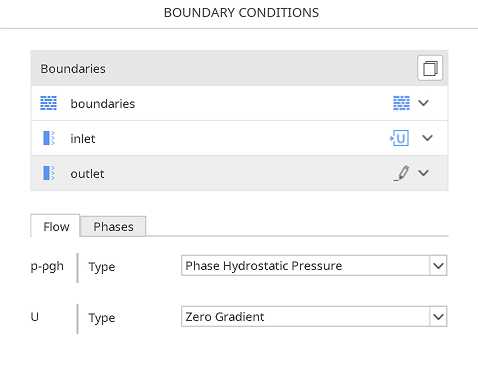
The definition requires the reference pressure \(p\), which usually represents the pressure at the top of the fluid or a point where the pressure is known.
Phase Hydrostatic Pressure - Alternatives
In this section, we propose boundary conditions that are alternative to Phase Hydrostatic Pressure. While they may fulfill similar purposes, they might be better suited for a specific application and provide a better approximation of physical world conditions.
| Boundary Condition | Description |
|---|---|
applies a static pressure condition in terms of pseudo-hydrostatic pressure \(p_{rgh}\), automatically accounting for gravity and density | |
imposes a constant static pressure at the boundary, without accounting for height or gravity | |
specifies total pressure at the boundary, commonly used in compressible or inlet/outlet flows | |
allows pressure to be extrapolated from the interior, useful for outflows or open boundaries |