Description
Recycled Temperature is a boundary condition that takes the temperature from an outlet patch (the average outflow temperature of a user-specified patch) and maps it onto an inlet patch, while applying a uniform heat addition. This simulates a scenario in which the fluid exits the domain, receives a consistent amount of heat (or energy), and then re-enters the domain at the inlet with an increased temperature.
This boundary condition is particularly useful for heat exchanger calculations where the outflow can be recycled back into the computational domain. It is often used in simulations where the domain represents only one segment of a larger repetitive or continuous system (e.g. a series of channels, repeating combustor stages, or a closed-loop system).
Understanding Recycled Temperature
Mathematically, Recycled Temperature can be written as:
However, instead of directly specifying a temperature offset, a uniform heat rate \(\dot Q\) \([W]\) is prescribed. From the heat rate \(\dot Q\), the temperature increase \(\Delta T\) can be calculated using the fluid properties (mass flow rate \(\dot m\) and specific heat capacity \(c_p\)):
Recycled Temperature inherits from the Fixed Value boundary condition. It operates similarly, but first computes the average temperature on the user-specified outlet patch and then offsets it by the resulting temperature increase.
Application & Physical Interpretation
Recycled Temperature is particularly well suited for heat exchanger simulations, where the outlet temperature information can be recycled and reintroduced into the domain through an inlet.
Physically, Recycled Temperature can be used to represent a situation where fluid leaving the domain passes through an external heater (not explicitly modeled) and then returns at a higher temperature.
Recycled Temperature in Heat Transfer applications
Example applications: heat exchangers, duct flows with thermal recirculation.
These types of simulations can be solved using the rhoPimpleFoam (solver). Consider a duct flow where a heat exchanger is located at the outlet. After passing through the heat exchanger, the fluid is recirculated back to the inlet at a higher temperature. Recycled Temperature can be applied at the inlet, while the temperature information is obtained from the outlet patch.
| Physics | Pressure | Velocity | Temperature |
|---|---|---|---|
Inlet | Total Pressure | Pressure Inlet-Outlet Velocity | Recycled Temperature |
Outlet | Fixed Value | Inlet-Outlet | Inlet-Outlet |
Recycled Temperature in SimFlow
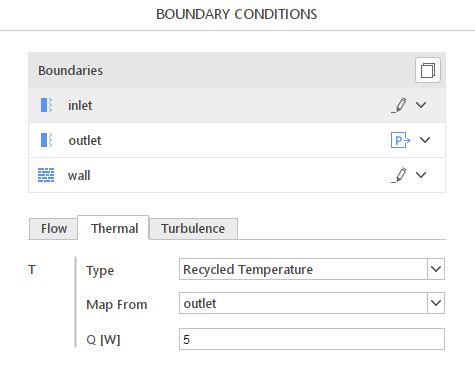
Recycled Temperature can be selected from the drop-down menu in the Boundary Condition panel. The user must specify the heat addition \(\dot Q\) \([W]\) - Figure 1.
Recycled Temperature - Alternatives
In this section, we propose boundary conditions that are alternative to Recycled Temperature. While they may fulfill similar purposes, they might be better suited for a specific application and provide a better approximation of physical world conditions.
| Boundary Condition | Description |
|---|---|
fixed value on the patch |