Description
Rough Wall Function (k) is a boundary condition that provides a wall function for the turbulent viscosity (\(\nu_t\)) when modeling rough walls using wall functions, based on the turbulent kinetic energy (\(k\)) to account for the effects of surface roughness.
Rough Wall Function (k) is particularly useful for simulating flows over surfaces where roughness plays a significant role, such as in pipes, ducts, or external flows over rough terrain. Surface roughness affects the velocity profile and increases the wall shear stress, leading to higher turbulence levels in the near-wall region. Unlike nutkWallFunction (smooth walls) or nutURoughWallFunction (velocity-based), this BC incorporates roughness corrections for accurate modeling of turbulent viscosity on rough surfaces.
Understanding Rough Wall Function (k)
The boundary condition modifies the wall function for the kinematic viscosity based on the roughness height of the wall. It essentially adjusts the turbulent viscosity by considering the impact of the roughness on the flow close to the wall.
The turbulent viscosity \(\nu_t\) is calculated according to the following formulas:
- \(k\) - Turbulent Kinetic Energy \([m^2/s^2]\)
- \(y\) - Wall-Normal Height \([m]\)
- \(y^+\) - Estimated Wall-Normal Height of the Cell Center in Wall Units
- \(C_\mu\) - Empirical Model Constant \([-]\)
- \(\nu_w\) - Kinematic Viscosity of Fluid Near Wall \([m^2/s]\)
- \(\nu_{t_{w}}\) - Turbulent Viscosity Near Wall \([m^2/s]\)
- \(\nu_{t_{lim}}\) - Limited Kinematic Viscosity Near Wall \([m^2/s]\)
- \(\kappa\) - von Kármán constant \([-]\)
- \(E\) - Wall Roughness Parameter \([-]\)
- \(E`\) - Modified Wall Roughness Parameter \([-]\)
- \(K_s\) - Sand-Grain Roughness Height \([m]\)
- \(K_s^+\) - Sand-Grain Roughness Height in Wall Units
- \(f_n\) - Roughness Function Parameter \([-]\)
- \(C_s\) - Roughness Constant \([-]\)
- \(u^*\) - Shear Velocity \([m/s]\)
Application & Physical Interpretation
Rough Wall Function (k) is crucial for accurately simulating flows over rough surfaces in turbulent conditions. By adjusting the kinematic eddy viscosity based on surface roughness, it allows for a more realistic representation of wall effects in CFD models.
This is particularly important in engineering applications such as pipelines, ducts, and channels where wall roughness plays a significant role in flow behavior.
Rough Wall Function (k) in Pipe Flow applications
Example applications: pipe or duct flow
These types of simulations can be solved using the simpleFoam (solver). In this case, we assume that the inner surface of the pipe is not perfectly smooth, but rather is characterized by some roughness.
Physics | Pressure | Velocity | \(k\) | \(\omega\) | \(\nu_t\) |
Pipe (Wall) | Zero Gradient | No-Slip | Standard Wall Function | Standard Wall Function | Rough Wall Function (k) |
Rough Wall Function (k) in Free Surface Flow applications
Example applications: hull flow analysis
These types of simulations can be solved using the interFoam (solver). In this case, the roughness of the hull is considered.
Physics | Modified Pressure | Velocity | \(k\) | \(\omega\) | \(\nu_t\) |
Hull (Wall) | Fixed Flux Pressure | Moving Wall Velocity | Standard Wall Function | Standard Wall Function | Rough Wall Function (k) |
Rough Wall Function (k) in SimFlow
To define Rough Wall Function (k) on the wall boundary, the proper option must be selected from the drop-down menu in the Turbulence tab - Figure 1. Please note that the Turbulence tab will be visible only if the turbulence equations are activated (Turbulence panel).
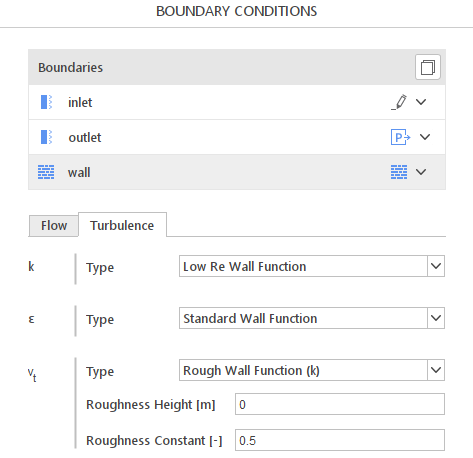
- Roughness Height - represents the equivalent sand grain roughness height in [m]
- Roughness Constant - Dimensionless constant that characterizes the type of roughness
Roughness constant is a parameter that measures how uniform the roughness is. Inputs may range from 0.5 to 1:- 0.5 indicates a uniform wall roughness
- 1 means that the roughness is strongly non-uniform, both in terms of spacing and height
Rough Wall Function (k) - Alternatives
In this section, we propose boundary conditions that are alternative to Rough Wall Function (k). While they may fulfill similar purposes, they might be better suited for a specific application and provide a better approximation of physical world conditions.
Boundary Condition | Description |
fixed value on the patch | |
similar to Rough Wall Function (k) but calculates \(\nu_t\) based on velocity |