Description
Turbulent Intensity Inlet specifies the turbulent kinetic energy based on the velocity prescribed at the inlet and user-supplied turbulence intensity. This condition is specifically designed for turbulent flows and is based on Inlet-Outlet. In case of reverse flow, Zero Gradient is applied. Unlike fixed value BC, this derives k from turbulent intensity and velocity for inlet conditions.
Understanding Turbulent Intensity Inlet
The boundary condition is designed for inlet boundaries where the turbulent kinetic energy (\(k\)) is not directly known but can be estimated from the turbulent intensity \(I\) and velocity field \(\vec U\).
The formula used in the calculation of this boundary condition is as follows:
- \(I\) - turbulence intensity \([\% ]\)
- \(\vec u\) - velocity field \([m/s ]\)
If the reverse flow appears on the boundary, a zero-gradient condition is applied:
\(\frac{dk}{dx} = 0\)
Turbulent Intensity Inlet is particularly useful in simulations where the exact details of turbulence at the inlet are not known, but an estimate of the turbulent intensity is available.
It is commonly used in simulations of industrial flows, environmental flows, and other scenarios where the flow is entering the computational domain and is expected to be turbulent, but detailed turbulence measurements are not available.
This boundary condition is suitable for both steady-state and transient simulations involving turbulence models like k-\(\epsilon\), k-\(\omega\), or others that require the specification of turbulent kinetic energy at the boundaries.
Turbulent intensity, often denoted as \(I\), is a measure used in fluid dynamics to estimate the level of turbulence in a flow. It is defined as the ratio of the root-mean-square (rms) of the velocity fluctuations to the mean flow velocity. The formula for turbulent intensity is:
- \(u'\) - the rms of the velocity fluctuations
- \(U\) - the mean flow velocity
The turbulent intensity is a dimensionless quantity and is typically expressed as a percentage. It gives an idea of how turbulent or chaotic the flow is compared to the mean flow.
To choose the proper level of turbulent intensity \(I\), the following recommendations can be followed:
- Nature of the Flow: The choice of turbulent intensity depends on the nature of the flow and the specific application. For example, flows in industrial pipes might have a different turbulent intensity compared to atmospheric flows.
- Literature and Experimental Data: Often, turbulent intensity values are chosen based on literature values or experimental data for similar flow conditions.
- General Guidelines:
- In industrial applications, a common range for turbulent intensity is between 1% and 10%.
- For external flows over objects (like air flow over a car or an airplane), a lower value of about 1% to 3% might be more appropriate.
- For internal flows in pipes or ducts, a higher value, such as 5% to 10%, might be used.
- In the absence of specific data, a default value of 5% is often a reasonable starting point.
Application & Physical Interpretation
The Turbulent Intensity Inlet is applied in simulations of turbulent flows to provide an accurate initial representation of turbulence. It defines the turbulence intensity, which is a measure of the fluctuations in velocity relative to the mean flow velocity. It is typically expressed as a percentage of the mean flow velocity.
Turbulent Intensity Inlet in Aerodynamics applications
Example applications: car, aircraft aerodynamics, wind tunnel experiment
These types of simulations can be solved using the simpleFoam (solver). This solver has two basic independent variables: pressure and velocity. Additionally, turbulence-related variables can be defined like turbulent kinetic energy, mixing length and others. The Turbulent Intensity Inlet can be applied to the domain inlet to represent turbulent flow when the exact measurements/profiles are not known.
| Physics | Pressure | Velocity | Turbulent Kinetic Energy | Turbulent Mixing Length Inlet |
|---|---|---|---|---|
Velocity Inlet | Zero Gradient | Surface Normal Fixed Value | Turbulent Intensity Inlet | Turbulent Mixing Length Inlet |
Outlet | Zero Gradient | Zero Gradient | Zero Gradient | Zero Gradient |
| Tutorial | Description |
|---|---|
External aerodynamic analysis based on the car example. The simulation case includes symmetry conditions and turbulence modeling. |
Turbulent Intensity Inlet in Compressible Internal Flow applications
Example applications: pipes and ducts
These types of simulations can be solved using the rhoPimpleFoam (solver). When the inlet properties of the flow field are not known and cannot be easily measured, Turbulent Intensity Inlet is a good initial set-up for the simulation to represent the turbulent flow properties.
| Physics | Pressure | Velocity | Temperature | Turbulent Kinetic Energy | Turbulent Mixing Length Inlet |
|---|---|---|---|---|---|
Velocity Inlet | Zero Gradient | Flow Rate Inlet Velocity | Fixed Value | Turbulent Intensity Inlet | Turbulent Mixing Length Inlet |
Outlet | Fixed Value | Pressure Inlet-Outlet Velocity | Inlet-Outlet | Inlet-Outlet | Inlet-Outlet |
Turbulent Intensity Inlet in SimFlow
Turbulent Intensity \(I\) is defined for the turbulence-related field k available in the boundary condition section. The proper option must be selected from the drop-down menu - Figure 1.
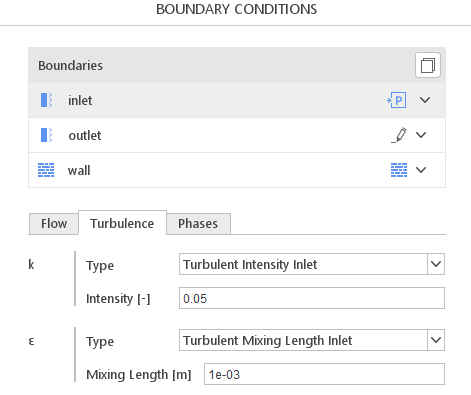
The value of \(I\) is required from the user.
Turbulent Intensity Inlet - Alternatives
In this section, we propose boundary conditions that are alternative to Turbulent Intensity Inlet. While they may fulfill similar purposes, they might be better suited for a specific application and provide a better approximation of physical world conditions.
| Boundary Condition | Description |
|---|---|
fixed value of \(k\) on the patch |