Description
Turbulent Mixing Length Inlet specifies the turbulent mixing length and the dissipation rate at the inlet of the computational domain. This condition is specifically designed for turbulent flows and is based on Inlet-Outlet. In case of reverse flow, Zero Gradient is applied. Unlike fixed value BC, this derives epsilon from k and mixing length for inlet conditions.
Understanding Turbulent Mixing Length Inlet
The formula used in the calculation of Turbulent Mixing Length Inlet is as follows:
- \(\epsilon\) - dissipation rate \([m^2/s^3]\)
- \(C_\mu\) - empirical model constant retrieved from turbulence model
- \(k\) - turbulent kinetic energy \([m^2/s^2]\)
- \(L\) - mixing length scale \([m]\)
If the reverse flow appears, the boundary condition switches to a zero-gradient condition:
\(\frac{d\epsilon}{dx} = 0\)
To choose the proper level of mixing length \(L\), the following recommendations can be followed:
- Understanding the Physical Problem:
The first step is to have a clear understanding of the physical problem and the flow characteristics. The mixing length should correspond to the size of the largest eddies in the turbulent flow. This is often related to the geometry of the problem – for example, the distance from a wall in boundary layer flows. - Based on Flow Geometry:
In many cases, the mixing length can be estimated based on characteristic lengths of the geometry. For instance, in boundary layer flows over a flat plate, it is often estimated as a proportion of the distance from the wall. - Empirical Formulas:
There are empirical formulas to estimate the mixing length. For example, in boundary layer flows, the mixing length \(L\) is often estimated using Prandtl’s mixing length hypothesis:
- \(κ\) is the von Kármán constant (approximately 0.41)
- \(y\) is the distance from the wall
- Using Experimental Data:
Whenever possible, it’s best to use experimental data or literature values specific to the type of flow you’re studying. This can provide a more accurate estimation of the mixing length. - Adjustments and Calibration:
The chosen value might need adjustments based on simulation results. It’s common to start with a theoretical or empirical value and then calibrate it based on comparison with experimental data or desired outcomes.
Application & Physical Interpretation
The Turbulent Mixing Length Inlet is applied in simulations of turbulent flows to provide an accurate initial representation of turbulence. The mixing length, typically estimated as a fraction of a characteristic length of the geometry (for example, the inlet diameter), is used to calculate the dissipation rate at the inlet of the domain.
Turbulent Mixing Length Inlet in Aerodynamics applications
Example applications: car, aircraft aerodynamics, wind tunnel experiment
These types of simulations can be solved using the simpleFoam (solver). This solver has two basic independent variables: pressure and velocity. Additionally, turbulence-related variables can be defined like turbulent kinetic energy, mixing length and others. The Turbulent Mixing Length Inlet can be applied to the domain inlet to represent turbulent flow when the exact measurements/profiles are not known.
| Physics | Pressure | Velocity | Turbulent Kinetic Energy | Turbulent Dissipation Rate |
|---|---|---|---|---|
Velocity Inlet | Zero Gradient | Surface Normal Fixed Value | Turbulent Intensity Inlet | Turbulent Mixing Length Inlet |
Outlet | Zero Gradient | Zero Gradient | Zero Gradient | Zero Gradient |
| Tutorial | Description |
|---|---|
External aerodynamic analysis based on the car example. The simulation case includes symmetry conditions and turbulence modeling. |
Turbulent Mixing Length Inlet in SimFlow
Turbulent Mixing Length Inlet \(L\) is defined for the turbulence-related field \(\epsilon\) available in the boundary condition section. The proper option must be selected from the drop-down menu - Figure 1.
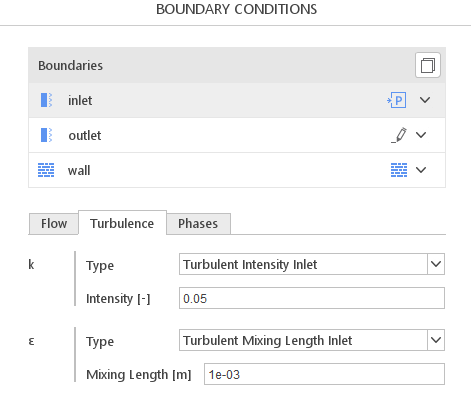
Mixing Length - mixing length
Turbulent Mixing Length Inlet - Alternatives
In this section, we propose boundary conditions that are alternative to Turbulent Mixing Length Inlet. While they may fulfill similar purposes, they might be better suited for a specific application and provide a better approximation of physical world conditions.
| Boundary Condition | Description |
|---|---|
fixed value of \(\epsilon\) on the patch |