Description
Uniform Total Pressure is a derivative of the Total Pressure boundary condition. It sets the static pressure on the domain boundary as a constant value or as a function of time, based on a specification of the total pressure \(p_{0}\).
In many cases, Uniform Total Pressure is recommended due to stability reasons. The boundary condition works differently depending on the flow regime: incompressible, subsonic compressible and supersonic compressible flows.
If one wants to define a pressure-driven flow, setting the static pressure by Fixed Value boundary condition may lead to instability of the solver because of the fixed pressure gradient, which constantly accelerates the flow.
Understanding Uniform Total Pressure
Uniform Total Pressure is applicable for both incompressible and compressible flows, though the total pressure definition is expressed in a different manner depending on the flow type. This boundary condition is similar to Total Pressure. However, the key distinction is its ability to define time-dependent values at the boundary.
Incompressible flows
For incompressible flows, the density of the fluid is assumed to be constant. Therefore, Uniform Total Pressure is typically applied at the inlet and outlet boundaries of the domain. This condition allows the solver to determine the velocity field consistent with the prescribed total pressure and boundary conditions.
Mathematically, Uniform Total Pressure can be expressed as:
\(p_{0} = p_{s} + 0.5 |\vec u|^2\)
where \(p_{s}\) is static pressure and \(p_{0}\) is total pressure.
Based on the above formula, the velocity \(U\) can be easily calculated as:
\(U = \sqrt{2(p_0-p)}\)
Please note that for incompressible flows, the flux is expressed in \([m^3/s]\) and pressure is expressed in
\([m^2/s^2]\) - the pressure is called the kinematic pressure.
Subsonic compressible
The pressure definition includes density and is expressed as below:
\(p_{0} = p_{s} + 0.5 \rho |\vec u|^2\)
Transonic compressible
For transonic compressible flow, the relation between static and total pressure looks as follows:
\(p_{s} = \frac{p_{0}}{1 + 0.5 \psi |\vec u|^2}\)
where \(\psi\) is compressibility (for fixed composition of gas) expressed as \(\psi = (RT)^{-1}\).
\(R\) represents gas constant and \(T\) represents temperature.
Supersonic compressible
Supersonic compressible flows use the 1D isentropic flow equation:
\(p_{s} = \frac{p_0}{(1 + \frac{\gamma-1}{2 \gamma} \psi |\vec u|^2)^{\frac{\gamma-1}{\gamma}}}\)
where \(\gamma = C_p/C_v\) is the ratio of specific heats for a given fluid.
Application & Physical Interpretation
Uniform Total Pressure is used for pressure-driven flows, where the velocity at the inlet is not known. Instead, the total pressure (also called stagnation pressure) can be prescribed for both incompressible and compressible types of flow.
Uniform Total Pressure in Channel/Pipe Flow applications (Incompressible Flows)
Example applications: pipe flow
These types of simulations can be solved using the pimpleFoam (solver). This solver has two basic independent variables: pressure and velocity. Additionally, turbulence-related variables can be defined. Uniform Total Pressure can be applied to the domain inlet if the velocity is not known.
| Physics | Pressure | Velocity |
|---|---|---|
Pressure Inlet | Uniform Total Pressure | Pressure Inlet Outlet Velocity |
Outlet | Fixed Value | Inlet Outlet |
Uniform Total Pressure in Multiphase applications
Example applications: free surface flows (free/entrainment boundaries), for example ship hull motion
The interFoam (solver) can be used for free surface modeling problems. When the free boundary exists in the domain, both inflow and outflow may occur on such a patch. zeroGradient for velocity and Fixed Value for pressure are not recommended as they may lead to instability. Instead, Uniform Total Pressure supports inflow and outflow through the boundary as well as improves the stability of the solution.
| Physics | Modified Pressure | Velocity |
|---|---|---|
Atmosphere | Uniform Total Pressure | Pressure Inlet Outlet Velocity |
Uniform Total Pressure in Combustion applications
Example applications: fire modeling in compartments, flame propagation
The reactingFoam (solver) can be used for flame propagation. To model stable flame behavior without risk of back flows, it is recommended to apply Uniform Total Pressure at the outlet.
| Physics | Pressure | Velocity | Temperature |
|---|---|---|---|
Outlet | Uniform Total Pressure | Pressure Inlet Outlet Velocity | Inlet Outlet |
Uniform Total Pressure in SimFlow
Incompressible flows
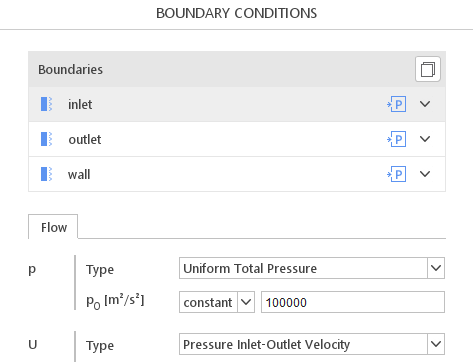
For incompressible flows, the only required parameter to be defined is the uniform total pressure \(p_{0}\). However, in SimFlow, all incompressible solvers use pressure divided by density. Such pressure is called the kinematic pressure and is expressed in \(m^2/s^2\) - Figure 1
Compressible flows
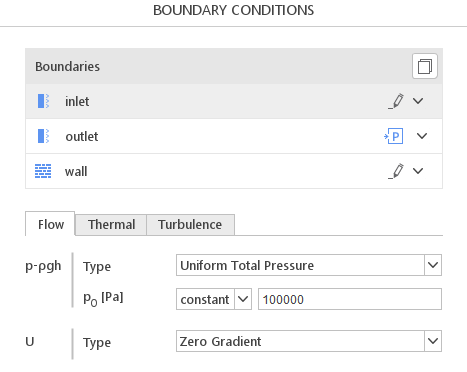
For compressible flows, the required parameter is total pressure \(p_{0}\) expressed in \(Pa\). The density \(\rho\) and heat capacity \(c_{p}\) are taken from material properties defined in the Thermo section - Figure 2.
Uniform Total Pressure - Alternatives
In this section, we propose boundary conditions that are alternative to Uniform Total Pressure. While they may fulfill similar purposes, they might be better suited for a specific application and provide a better approximation of physical world conditions.
| Boundary Condition | Description |
|---|---|
similar boundary condition, but it does not allow defining time-dependent total pressure | |
the most basic boundary condition, where the value of a variable (like pressure) is fixed across the boundary. It is used in scenarios where the boundary value is known and constant (it defines static pressure). | |
uniform value on the patch, which varies over time |