Description
Wave Transmissive is a boundary condition used to model open boundaries where waves or free-stream flows should pass through the computational domain without reflection or introducing significant disturbances. It is commonly applied in atmospheric flow simulations, marine applications, and other cases requiring realistic wave transmission across domain boundaries.
Typical boundary conditions in CFD, like Fixed Value or Zero Gradient, are not always suitable for open boundary cases because they don’t represent the physical reality of an open, infinite domain. For instance, a Fixed Value condition imposes a strict state at the boundary, while a Zero Gradient condition assumes no change in the property’s value across the boundary. Both can cause unphysical reflections of waves at the boundary.
The Wave Transmissive condition is implemented to mitigate these issues. It allows waves (or any disturbances) originating within the computational domain to leave the domain at the boundary with minimal reflection.
Understanding Wave Transmissive
The boundary value is determined by solving the following equation:
- \(\frac{D}{Dt}\) - material derivative
- \(\vec U\) - advection velocity
The Wave Transmissive boundary condition calculates the advection velocity using the following formula:
- \(\gamma\) - ratio of specific heats \(C_p/C_v\)
- \(\psi\) - compressibility
Application & Physical Interpretation
The Wave Transmissive boundary condition is designed to minimize wave reflection at open boundaries. It is particularly critical in compressible flows where shock waves must exit the domain, or in free surface flows where water waves should propagate outward without bouncing back. Its physical interpretation relies on the characteristic method, ensuring information travels out of the domain at the correct speed.
Wave Transmissive in High-speed compressible flows
Example applications: aerodynamics around aircraft, supersonic nozzle flow, blast waves.
These simulations are often solved using rhoCentralFoam (solver), which handles high-speed compressible flows. The Wave Transmissive boundary condition can be used at the domain’s outer boundaries to allow shock waves and acoustic waves generated by the object to exit the domain without reflecting back. This is crucial for accurately capturing the wave patterns and interactions in supersonic flows.
Physics | Pressure | Velocity |
Far-field Boundary | Wave Transmissive | Inlet Outlet |
Inlet | Fixed Value | Fixed Value |
Wall | Zero Gradient | No Slip |
Wave Transmissive in Free surface flows
Example applications: waves in oceans, tanks, coastal engineering.
These simulations are often solved using interFoam (solver), which handles multiphase flows. When simulating surface waves, Wave Transmissive boundaries can be used at the domain edges to simulate an open ocean or tank environment. This allows generated waves to leave the simulation domain realistically, mimicking the natural dissipation of waves in a large body of water.
Physics | Pressure | Velocity |
Wave Outlet | Wave Transmissive | Inlet Outlet |
Atmosphere | Total Pressure | Pressure Inlet Outlet Velocity |
Seabed | Fixed Flux Pressure | No Slip |
Wave Transmissive in SimFlow
The Wave Transmissive boundary can be selected from the drop-down menu for pressure p - Figure 1.
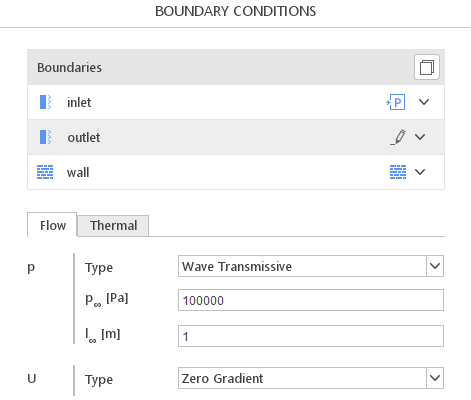
Two parameters must be defined by the user:
\(p_\infty\) - represents far-field or infinite-field value of pressure. This is the expected value of the field at a great distance from the boundary.
\(l_\infty\) - characteristic length scale used to control the behavior of the boundary condition.
A larger \(l_{\infty}\) value means the boundary condition will allow more deviation from the fieldInf state, leading to less influence from the far-field conditions and potentially more wave transmission with less reflection. Conversely, a smaller lInf value makes the boundary condition more reflective, as it tries to hold the boundary values closer to fieldInf. This can be useful in situations where some level of wave reflection or a stronger enforcement of the far-field conditions is desirable or acceptable.
Wave Transmissive - Alternatives
In this section, we propose boundary conditions that are alternative to Wave Transmissive. While they may fulfill similar purposes, they might be better suited for a specific application and provide a better approximation of physical world conditions.
Boundary Condition | Description |
Imposes a constant value at the boundary. Suitable for scenarios where the boundary state is known and fixed, but can cause wave reflections. | |
Assumes no change in the variable across the boundary. Useful for outflow conditions but may not adequately handle wave transmission. |