Simulation
Simulation Type Wizard
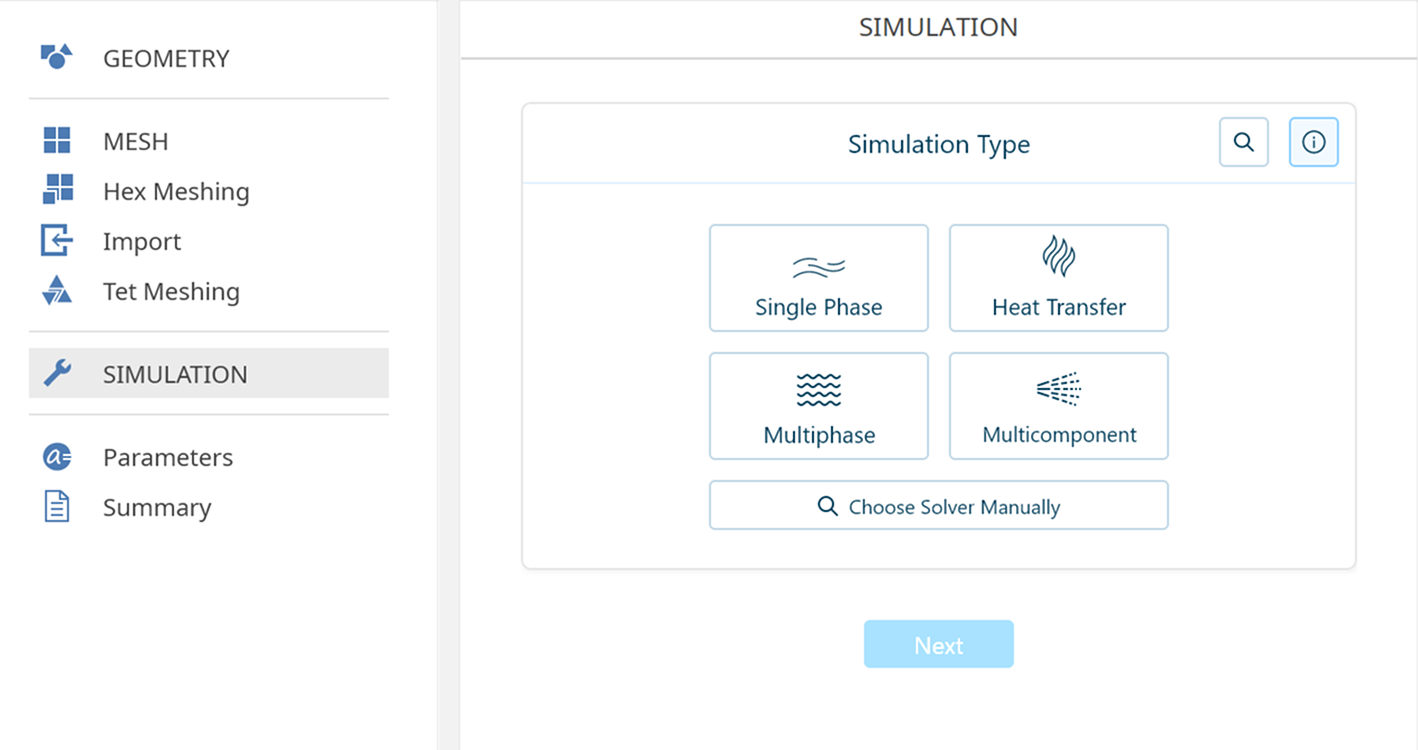
To run a simulation in SimFlow, you must select a solver that is appropriate for your case. Each solver represents a predefined combination of models tailored for a particular class of simulations.
To simplify solver selection, SimFlow provides the Simulation Type wizard.
The wizard is intentionally simple:
- In the wizard steps, you choose high-level options that match your target simulation.
Each choice progressively narrows down the simulation intent
(single-phase vs multiphase, compressible vs incompressible, steady vs transient). - SimFlow automatically selects a recommended default solver that matches your choices.
- You can select a solver variant that supports advanced features (for example Overset) using the Modify option on the confirmation screen.
- Once you are confident in your selection, you confirm the resulting solver.
After confirmation, the final solver is selected and the corresponding set of simulation configuration panels is loaded in the navigation tree on the left-hand side.
Confirmation Screen
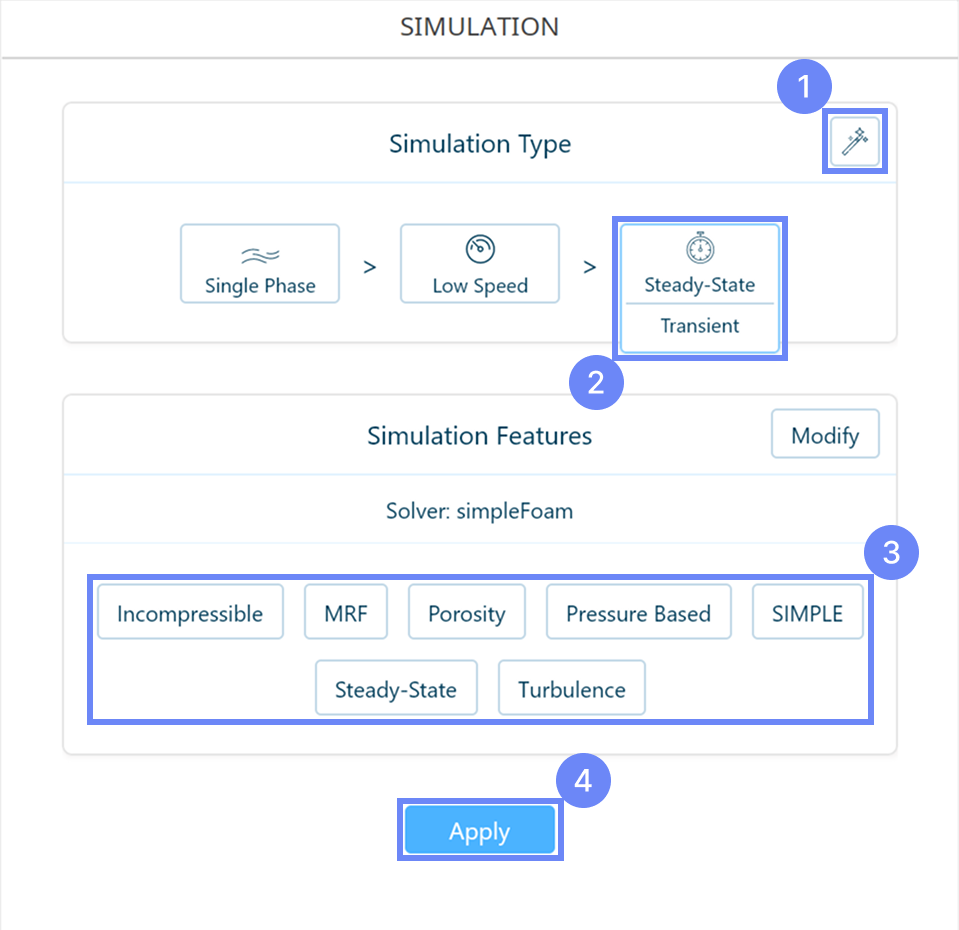
After completing the wizard steps, SimFlow displays a confirmation screen. This screen summarizes your selections and allows you to validate the chosen solver.
If you want to start over and adjust your selections, use the Wizard button 1. You can also quickly modify your choices using the breadcrumb summary 2.
To verify whether the solver is suitable for your case, review the Simulation Features list 3.
When you are satisfied with your selection, confirm it using the Apply button 4.
Modify - Advanced Options
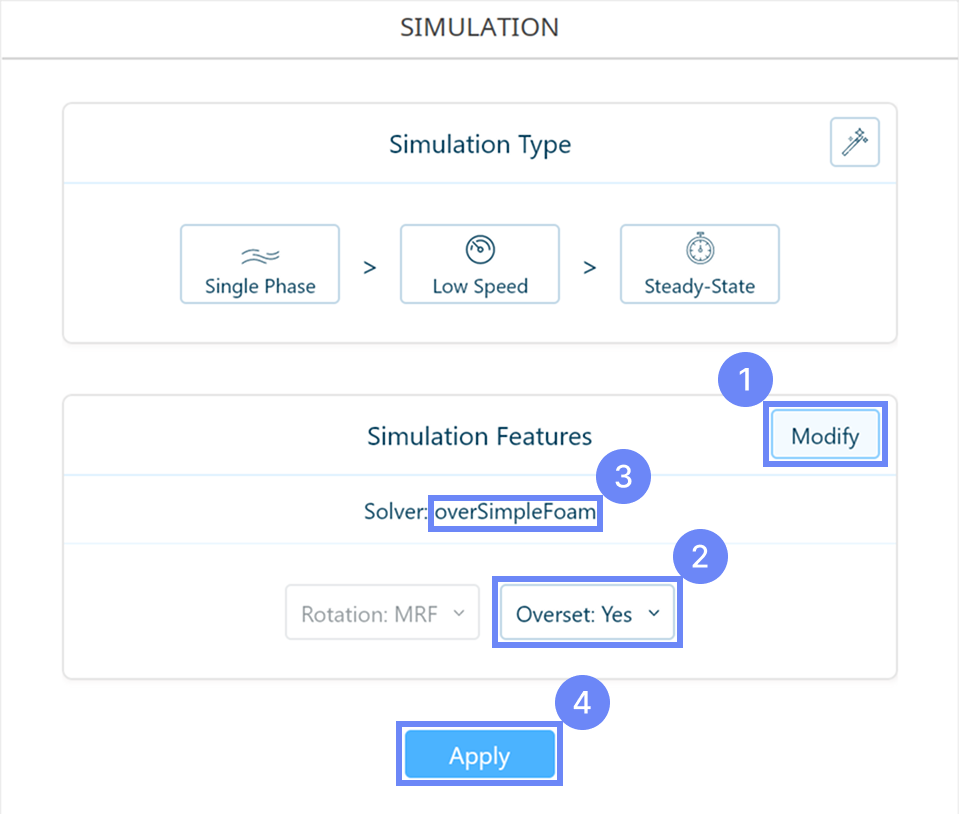
On the confirmation screen, a Modify button 1 may be available. This button allows you to adjust advanced features associated with your selected simulation type 2. Based on these changes, SimFlow selects a different built-in solver 3 that matches the requested capabilities.
Use Modify to configure advanced options such as:
- Overset or Dynamic Mesh solver variant
- Gravity
- Volume of Fluid interface capturing method
- etc.
Disable Info
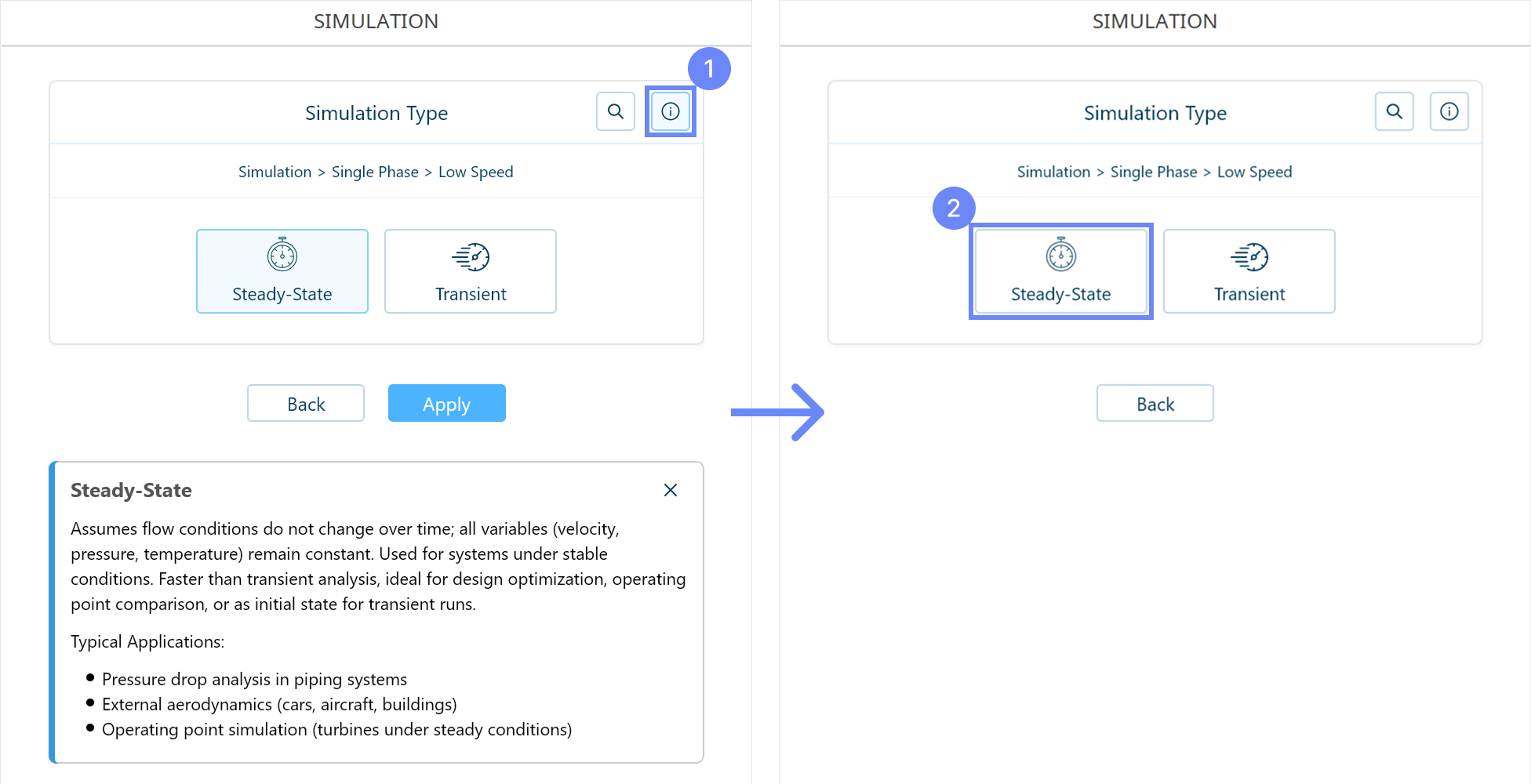
The wizard includes an Info panel that explains each selected option. If you are already familiar with the wizard steps, you can disable the Info panel to speed up the selection process. When this option is disabled, the wizard automatically proceeds to the next step as soon as you select an option.
Select Solver by Name
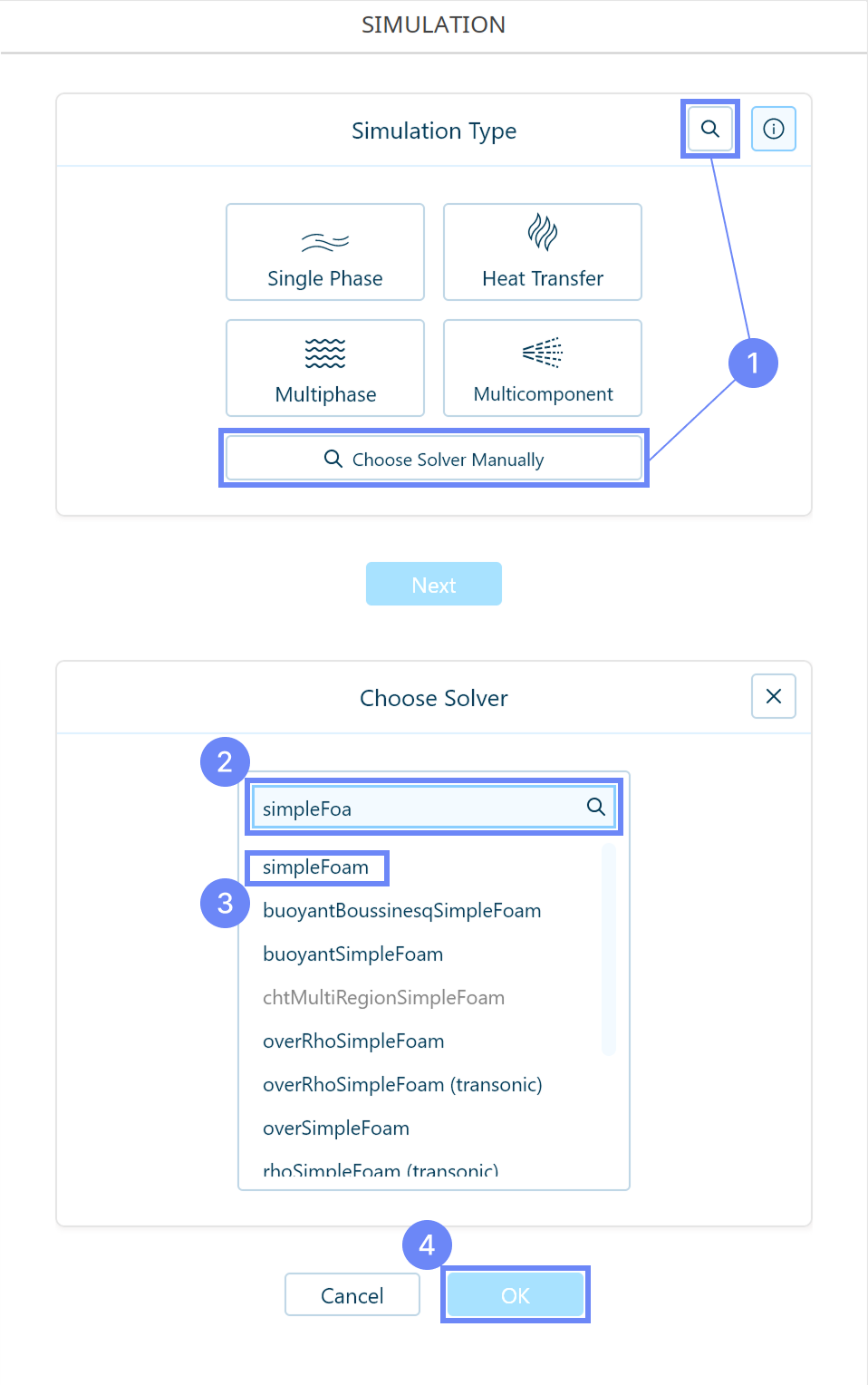
Simulations are closely associated with a specific OpenFOAM solver. The wizard is the recommended way to select a solver when you are unsure which one to use. Use Solver Search when you already know the OpenFOAM solver name or want to quickly select a familiar solver.
- 1 Open the Choose Solver dialog by clicking Choose Solver Manually.
- 2 Enter part of the solver name.
- 3 Select the solver from the list.
- 4 Confirm with OK.
Tip | Some solvers may be disabled due to mesh or results limitations. |
Limited Simulation Types
In some situations, not all simulation types are available.
This can occur when:
- Your case uses a multi-region mesh.
- Results already exist on disk.
CHT vs Single-Region Mesh
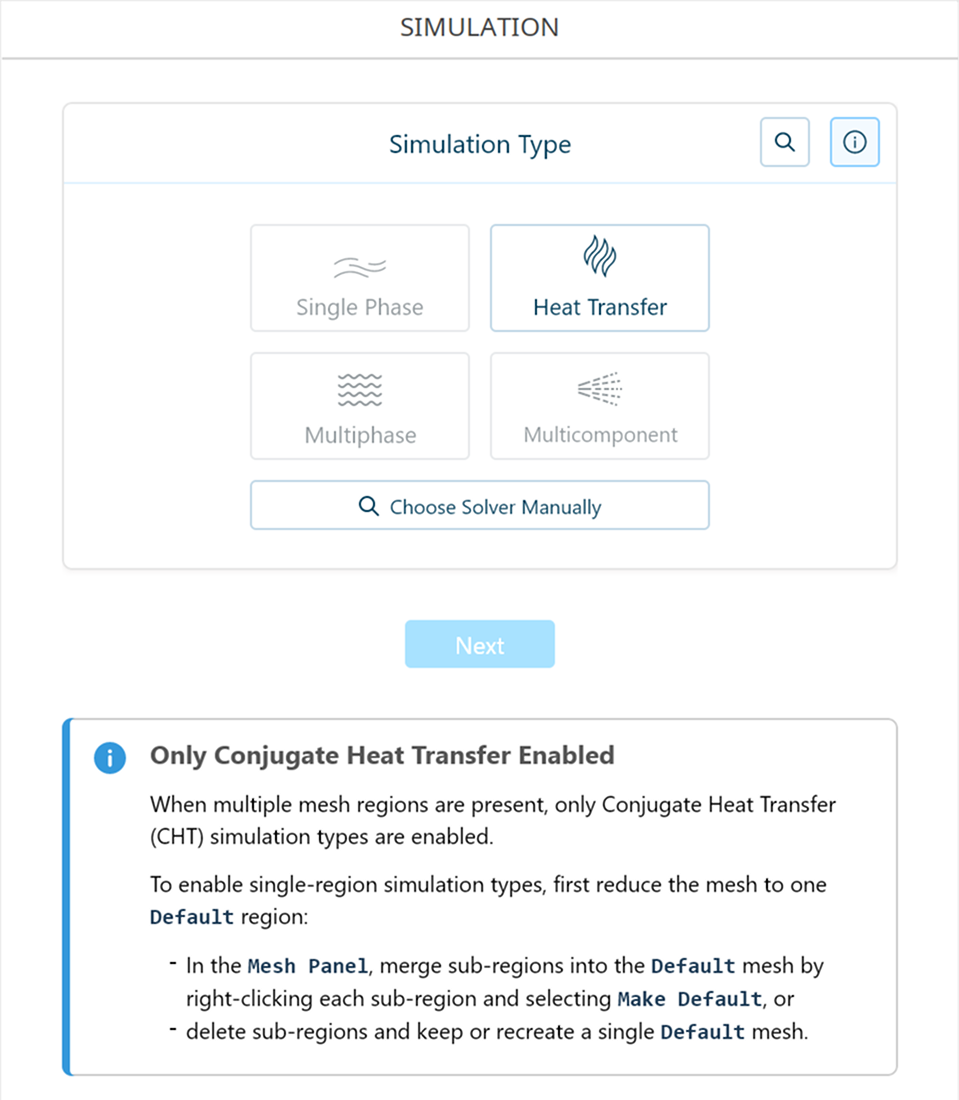
Single-Region simulations require exactly one mesh region (the Default region).
CHT (Conjugate Heat Transfer) simulations require multiple regions (for example fluid and solid) connected by an interface.
In practice, this means:
- With a single-region mesh, CHT options are disabled.
- With a multi-region mesh, only CHT options are enabled.
To switch between single-region and CHT simulation types, first modify your mesh regions in the Mesh panel.
Results Present
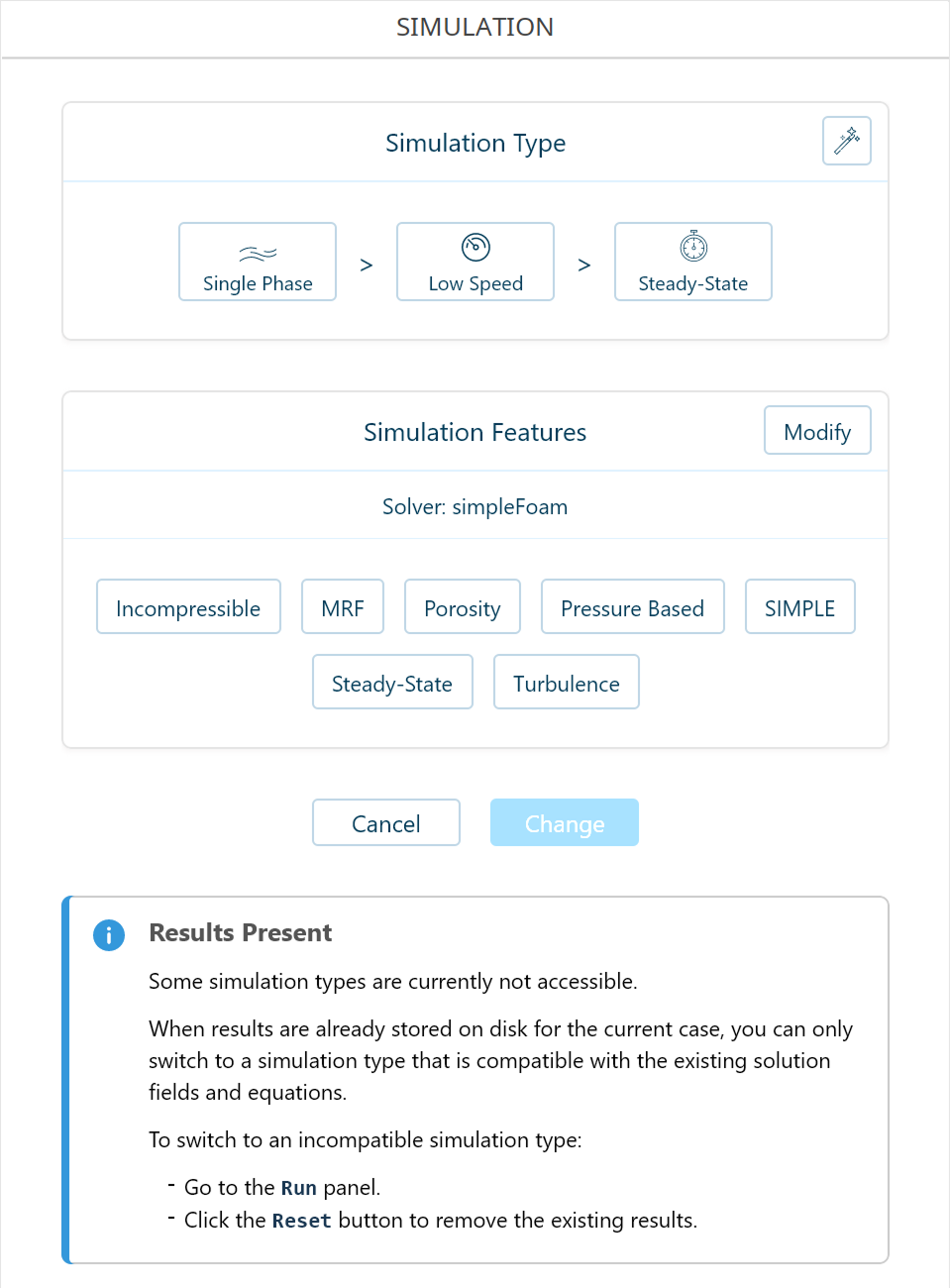
If results already exist for the current case, not all simulation types can be selected.
In this situation:
- Some options are disabled.
- You can only switch to simulation types compatible with the existing fields and equations.
To switch to an incompatible simulation type, reset the results in the Run panel.
Change Already Selected Solver
After completing the wizard, the final solver details view is displayed. You can change the selected solver at any later time. However, the available simulation types may be limited by your mesh configuration and existing results.
To change the solver, click Change Simulation Type on the confirmation screen and use the wizard or Solver Search to select a new solver.
SimFlow version < 5.0.64
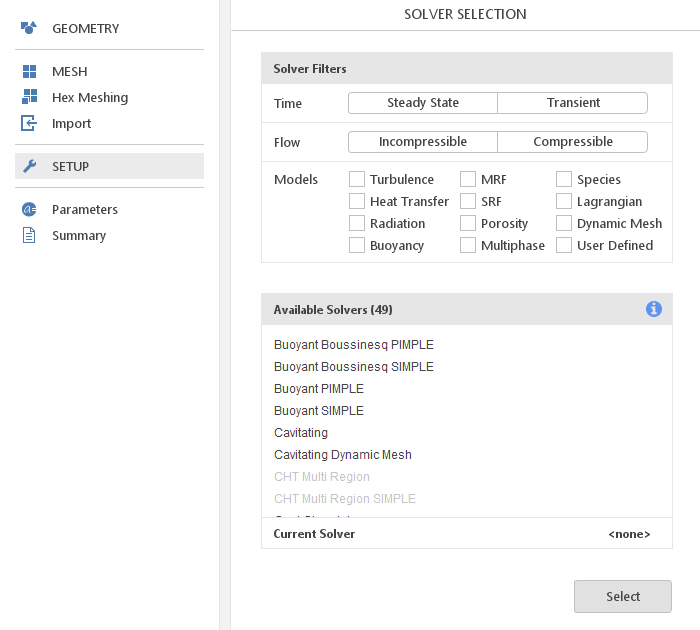
Earlier versions of SimFlow used a different approach to solver selection. Instead of the Simulation Type Wizard, users selected solvers directly from a list of available solvers.
Solver Filters
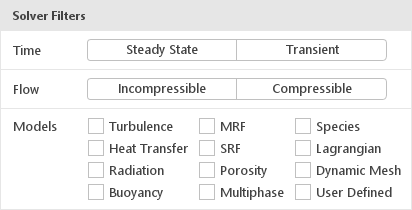
There is a large number of specialized solvers available. To simplify solver selection, a set of filters is provided. These filters allow you to specify which models you are interested in, reducing the number of visible solvers.
There are three main filter categories:
- Time
- Flow
- Models
Note: Filters are optional. You can select a solver directly from the list if you prefer.
Time Filters

The Time filters allow you to specify whether you need a steady-state or transient solver.
Flow Filters

The Flow filters allow you to specify whether the solver should handle incompressible or compressible flow.
Model Filters
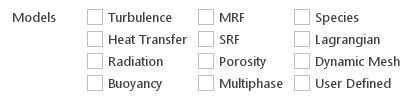
The Models filters allow you to specify which physical models are required for your simulation. For certain combinations of models, no solver may be available.
Solver Setup
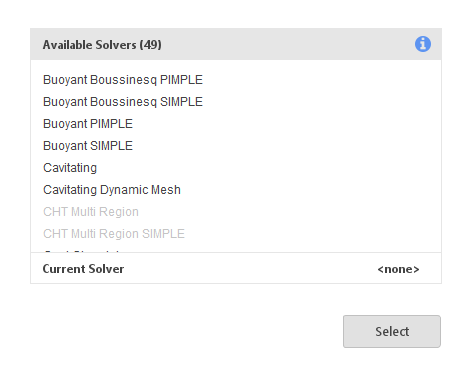
To configure SimFlow for your simulation, select a solver from the Available Solvers list. Once a solver is selected, the Select button becomes active. Clicking this button configures SimFlow to use the chosen solver and displays a new set of options in the program tree.
Solver Description
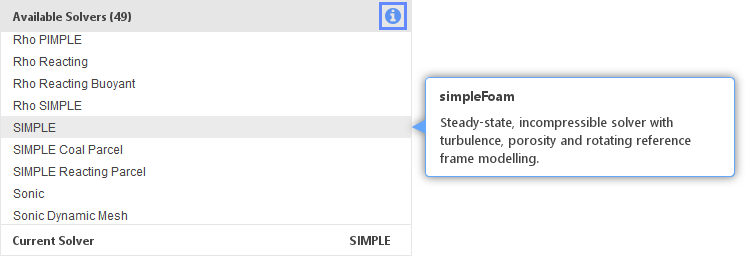
When you select a solver from the Available Solvers list, a short description is displayed next to the solver name. If you are already familiar with the solvers, you can disable these descriptions by clicking the Show Solver Description button.
In some situations, a solver may be unavailable. In such cases, the solver description provides additional information explaining why the solver cannot be selected.