Turbulence
Introduction
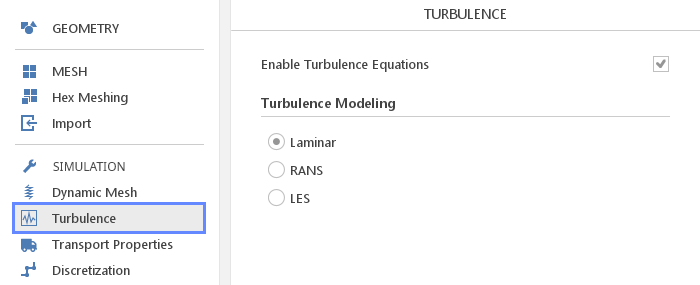
In the Turbulence panel you can enable turbulence models appropriate for your simulation.
Enabling and Disabling Turbulence

In certain situations, it can be useful to disable the turbulence model at the beginning of the simulation. This can be done using the Enable Turbulence Equations button and is usually used to stabilize the simulation. The turbulence model can be enabled or disabled even while the simulation is still running.
Turbulence Modeling
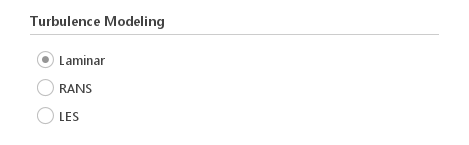
You can select one of three approaches to turbulence modeling:
- Laminar - no turbulence modeling is used, applicable for very low velocity flows
- RANS - Reynolds-Averaged Navier-Stokes is the most widely used modeling approach, which offers a balance between accuracy and computational cost
- LES - Large Eddy Simulation offers improved modeling of large turbulent structures but is very computationally intensive
RANS Models
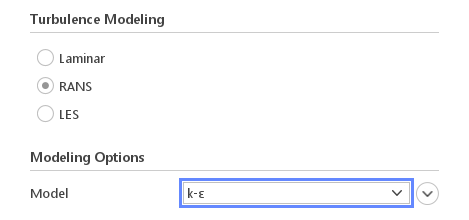
When you select RANS turbulence modeling, you will only have to define a Model .
Currently available models are:
- \(k-\epsilon\)
- \(RNG k-\epsilon\)
- \(Realizable k-\epsilon\)
- \(Spalart-Allmaras\)
- \(k-\omega\)
- \(k-\omega SST\)
- \(k-\omega SST SAS\)
- \(k-kl-\omega\)
Available models will vary depending on the version of OpenFOAM you are using and the solver that is currently selected.
Model Constants
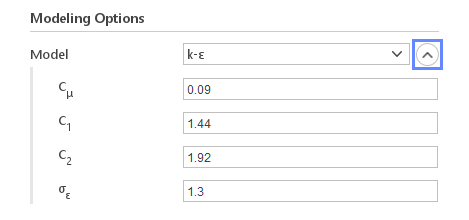
Most models require some constants to be specified. You can edit these constants by clicking the Expand button. Usually, you should not change the default values.
LES Models
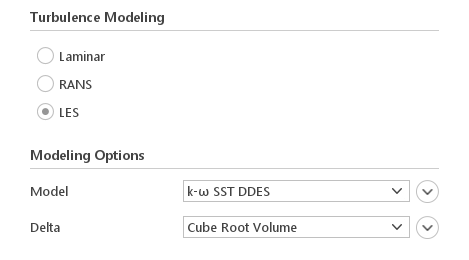
When you select LES modeling, you will be able to specify:
- Model - LES or DES model to use
- Delta - method for determining cutoff length scale
- Filter – if the selected model requires it, you can select the type of the LES filter
Currently, available LES models:
- \(k-\omega SST DDES\)
- \(k-\omega SST IDDES\)
- \(k-\omega SST DES\)
- \(Spalart-Allmaras DES\)
- \(Spalart-Allmaras DDES\)
- \(Spalart-Allmaras IDDES\)
- \(Smagorinsky\)
- \(WALE\)
- \(k Equation\)
- \(Dynamic k Equation\)
Delta Calculation Methods

Currently, available Delta calculation methods:
- Cube Root Volume
- Max Delta XYZ
Inputs:
- Coefficient
Filter Operators
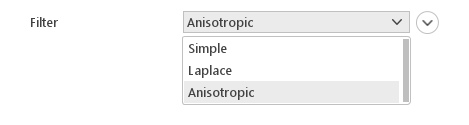
For the Dynamic k Equation model, there are available Filter operators:
- Simple
- Laplace
- Anisotropic
Inputs:
- Width Coefficient